Source Migration: Bitbucket to GitHub
Source Migration: Bitbucket to GitHub
Overview
As part of our developer platform modernization, we migrated 500+ active repositories from Bitbucket to GitHub—without disrupting ongoing development or CI pipelines.
This was not a repository transfer. It was a live platform transition:
- Hundreds of developers continued contributing daily—shipping SaaS features and bug fixes without interruption
- CI pipelines remained operational
- Collaboration history (PRs, reviews, comments) was fully preserved
The migration was executed over a single weekend, backed by weeks of preparation, automation, and cross-team coordination.
This document focuses on how we executed the migration at scale—the decisions, structure, and operating model that made it possible.
Execution Complexity
The challenge was not defining constraints—it was executing against them at scale without breaking active development.
Key complexities included:
- Coordinating hundreds of repositories with different sizes, histories, and ownership
- Running migration alongside active development—without creating drift or conflicts
- Ensuring consistency in repository rules, permissions, and structure post-migration
- Eliminating manual effort to avoid errors during a high-volume migration
- Managing a diverse repository landscape—from highly active to less active—each with different risk profiles
- Reconciling inconsistent rules and permission models that had evolved differently across teams over time
- Mapping hundreds of historical contributors to GitHub identities while preserving attribution
This required treating the migration as a repeatable, automated system, not a one-time activity.
Execution Model: Parallel Workstreams
To execute within a constrained timeline, we structured the work into parallel streams:
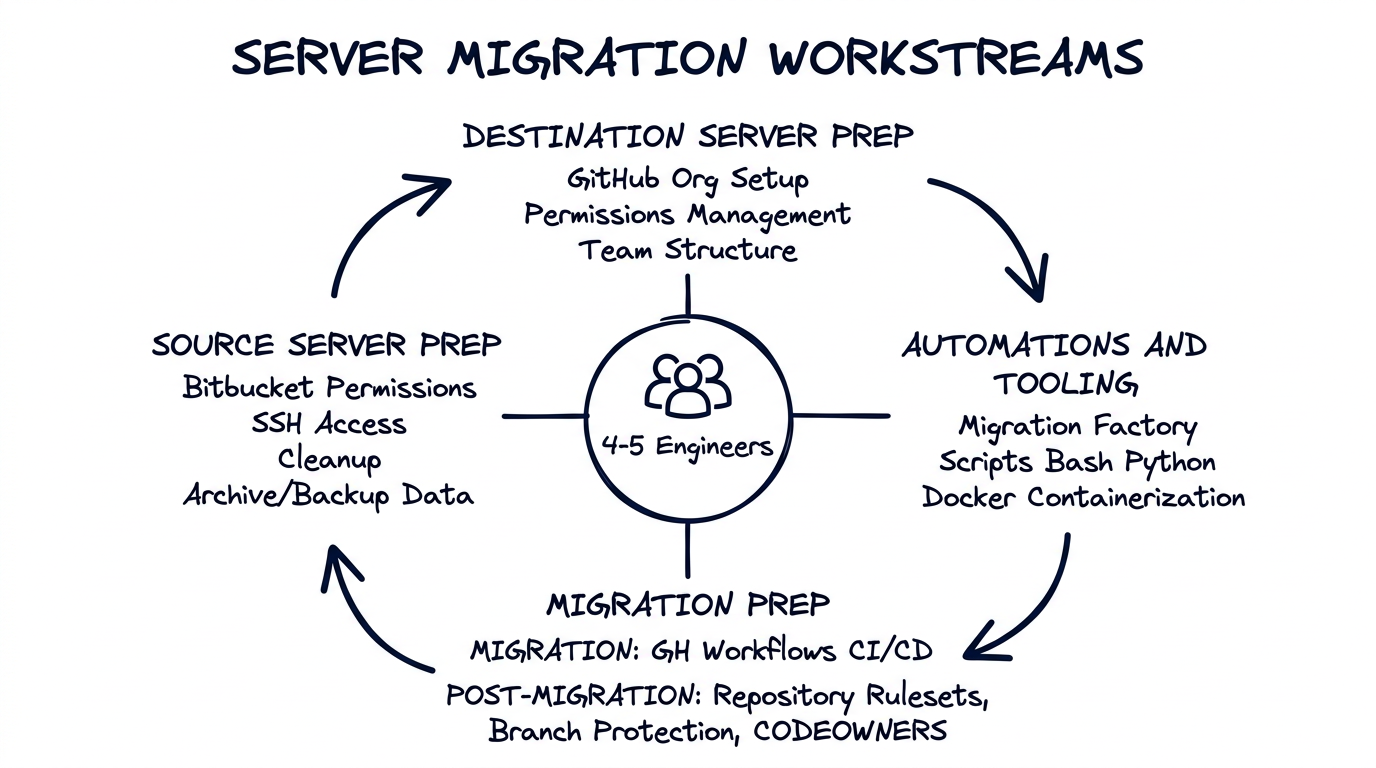
- Source Preparation — Repository cleanup, access validation, large file handling, and readiness checks
- Destination Setup (GitHub) — Organization structure, team mapping, permissions, and baseline policies
- Migration Automation — Tooling, orchestration workflows, batching strategies, and execution pipelines
- Post-Migration Enablement — Repository rules, identity mapping, CI integration, and developer onboarding
This structure allowed teams to move independently while staying aligned on outcomes—avoiding bottlenecks inherent in a sequential approach.
Migration Phases
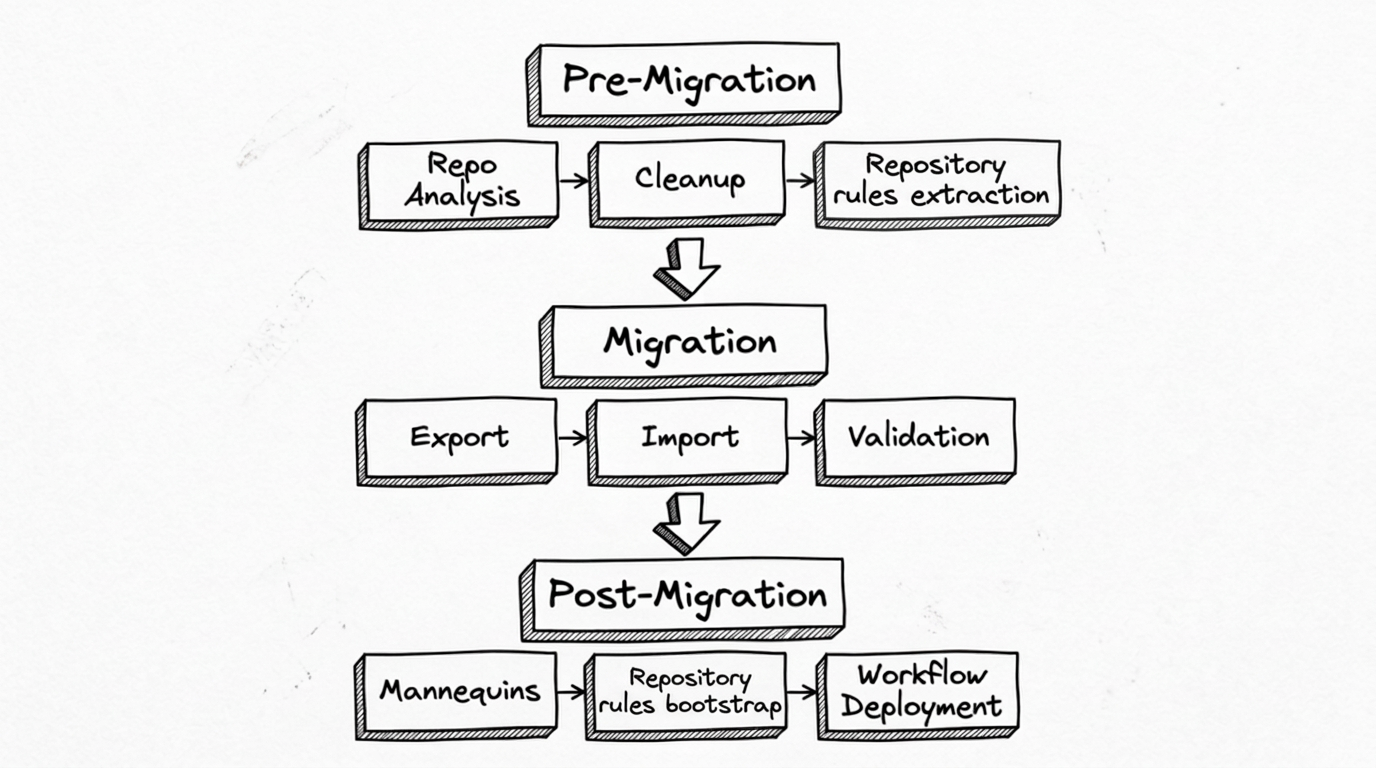
We divided the migration into three clear phases:
Pre-Migration
- Repository analysis and cleanup
- Large blob removal and LFS alignment
- Branch pruning and standardization
- Extraction of repository rules and configurations
Migration
- Execution using automated workflows
- Repository batching and orchestration
- Validation of migrated data and metadata
Post-Migration
- Reapplying repository rules and protections
- Identity mapping (user reconciliation)
- CI/CD integration and validation
- Developer onboarding and environment readiness
Separating these phases ensured issues were caught early, execution remained predictable, and post-migration was fully operational—not an afterthought.
For each repository, the same flow was followed:
Migration Strategy: Simple vs Complex
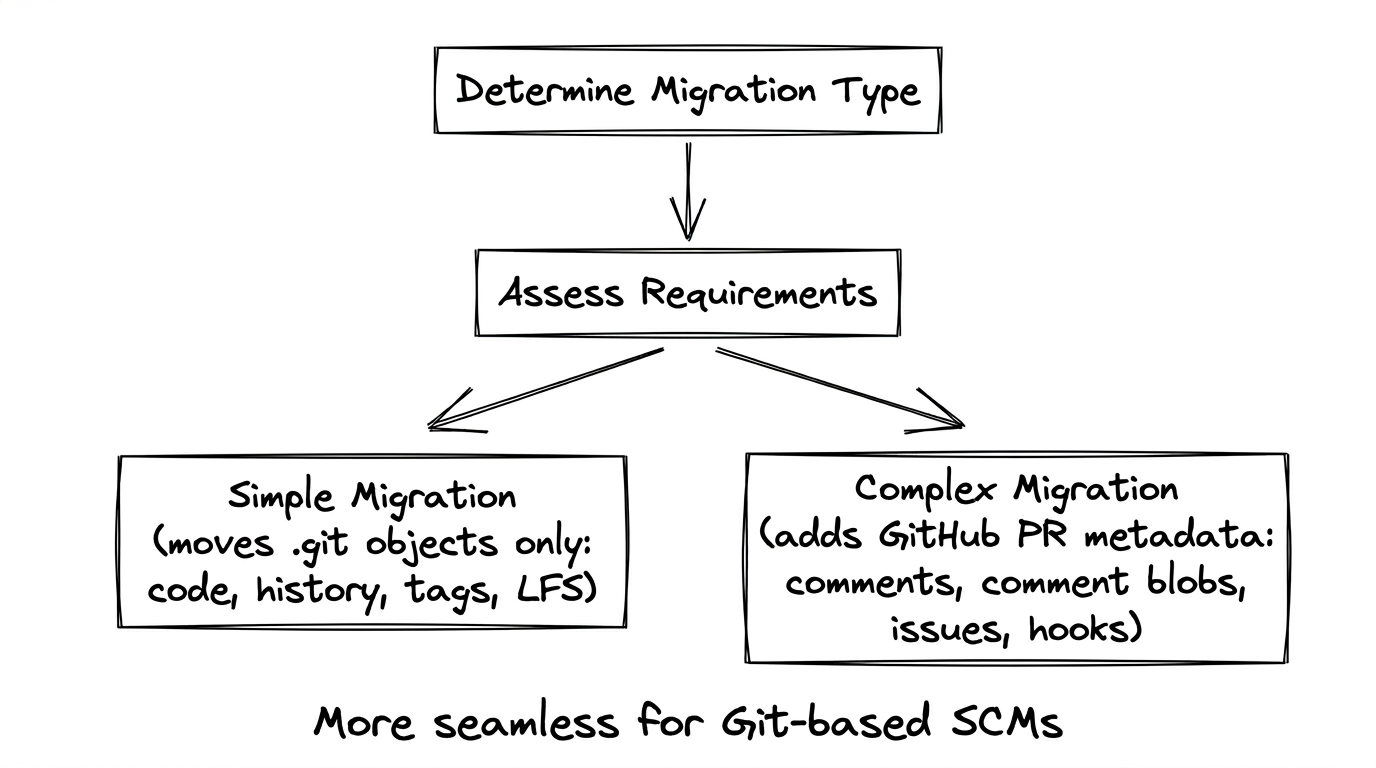
Within the migration phase, the first critical decision was choosing the type of migration.
| Capability | Code-Only Migration | Full-Fidelity Migration |
|---|---|---|
| Code & commit history | ✓ | ✓ |
| Tags & LFS | ✓ | ✓ |
| Pull requests | ✓ | |
| Reviews & comments | ✓ | |
| Integrations (hooks, JIRA) | ✓ |
- Code-only migration is simpler and faster, but loses collaboration history
- Full-fidelity migration preserves how teams actually work
For our organization, collaboration history was non-negotiable. Years of pull request discussions and reviews contained critical engineering context.
We chose full-fidelity migration, using GitHub Enterprise Importer for Bitbucket Server.
This decision significantly increased complexity—but ensured continuity for engineers.
Implementation Details
For a deeper technical dive, read the phases in order (1, 2, 3), then automation (4) to see how we orchestrated it at scale:
| Serial Number | Title | Link |
|---|---|---|
| 1 | Pre-Migration Steps | Read → |
| 2 | Migration: Bitbucket to GitHub | Read → |
| 3 | Post-Migration Setup | Read → |
| 4 | Our Automation (orchestrates all phases) | Read → |
What Made This Work
Several factors were critical to executing the migration successfully:
- Automation-first approach — manual execution was not viable at this scale
- Clear ownership across workstreams — avoided coordination bottlenecks
- Strong pre-migration discipline — most issues were resolved before execution
- Phased execution model — reduced risk and improved predictability
Without these, the migration would not have been feasible within the timeline.
Outcomes
The migration achieved its goals without compromising delivery:
- 500+ repositories migrated in a single weekend
- Full collaboration history preserved — PRs, comments, reviews, and authorship
- Repository health improved through cleanup and standardization
- Faster clone and checkout times across developer and CI environments
- Reusable migration tooling adopted across the organization, enabling 1,000+ repositories to follow a standardized model and extend to other source control systems, including GitLab, Subversion (SVN), and Perforce.
- CI pipelines remained fully operational with no disruption
What This Enabled
With source control standardized on GitHub, we established a foundation for the next phase of platform evolution:
- CI modernization (Bamboo → GitHub Actions)
- Standardized repository policies and automation
- Improved developer experience across teams
This migration was not just a transition—it established a repeatable platform capability for the organization.
Acknowledgements
Thanks to this wonderful team who turned this around quickly—and the many others involved!
 Anand Arya
 Chinua
 Ira Porchia
 Karthik Donthy
 Niranjan Kunda
 Shriram Jaju
 Vikesh Kumar